UPI Completes 10 Years: India’s Digital Payments Revolution
UPI Completes 10 Years of Digital Payments Revolution
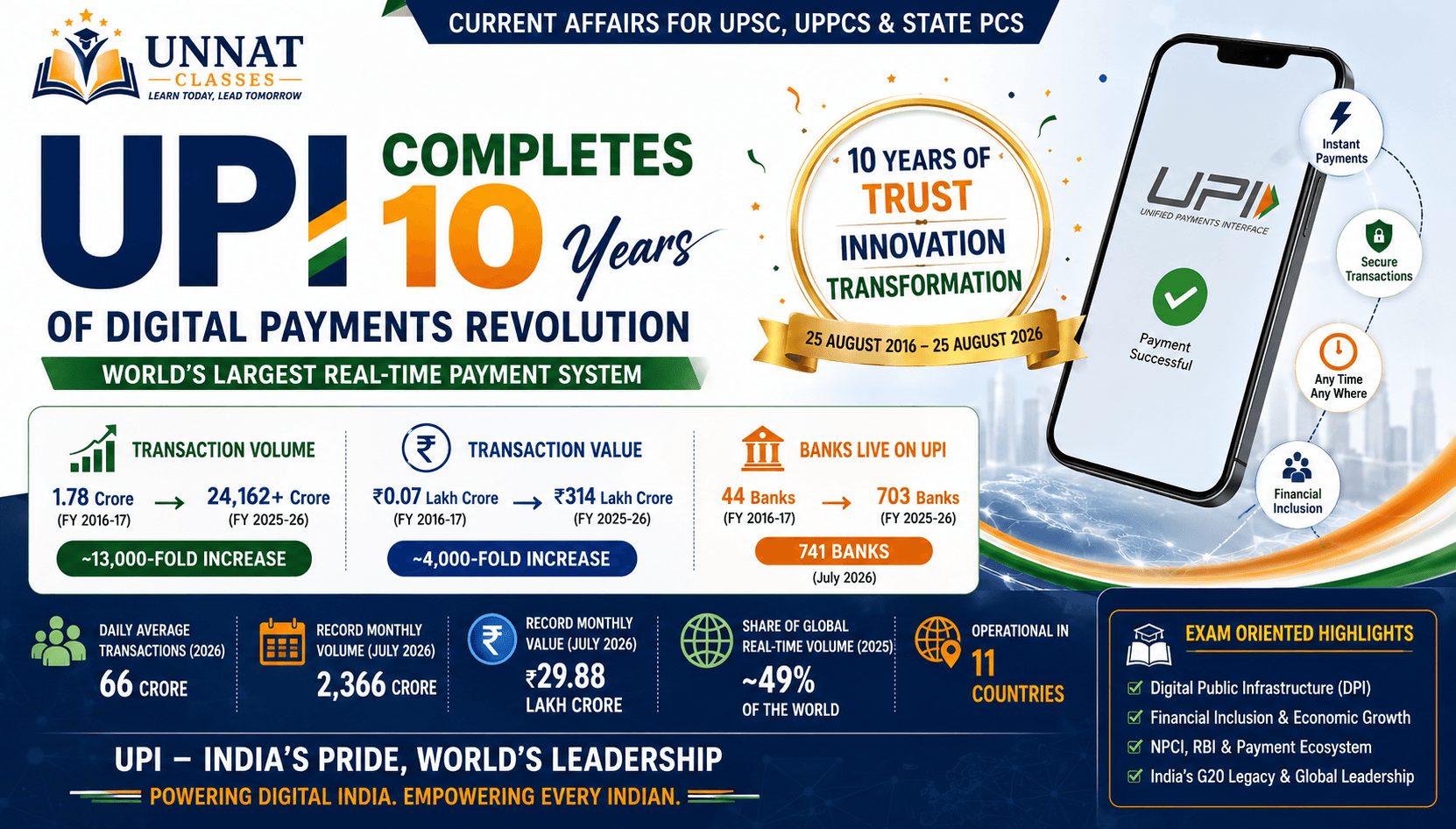
The Unified Payments Interface (UPI) completes 10 years of operations on 25 August 2026.
Launched in 2016 by the National Payments Corporation of India (NPCI) under the regulatory oversight of the Reserve Bank of India (RBI), UPI has emerged as the backbone of India's digital payments ecosystem.
Over the past decade, UPI has transformed the way individuals, businesses and merchants conduct financial transactions.
It has become a major pillar of India's Digital Public Infrastructure (DPI) and an important driver of financial inclusion.
UPI: Key Facts at a Glance
Launch Date: 25 August 2016
Organisation: National Payments Corporation of India (NPCI)
Regulatory oversight: Reserve Bank of India (RBI)
Annual transactions in FY 2016–17: 1.78 crore
Annual transactions in FY 2025–26: 24,162+ crore
Transaction volume increase: Nearly 13,000-fold
Transaction value in FY 2016–17: ₹0.07 lakh crore
Transaction value in FY 2025–26: Approximately ₹314 lakh crore
Transaction value increase: More than 4,000-fold
Daily average transactions in 2026: 66 crore
Record monthly transactions: 2,366 crore in July 2026
Record monthly value: ₹29.88 lakh crore in July 2026
Banks live on UPI: 741 as of July 2026
Countries where UPI is operational: 11
Global real-time payment volume share: Nearly 49% in 2025
A Decade of Extraordinary Growth
UPI has witnessed unprecedented growth in both transaction volume and transaction value.
Transaction Volume
Annual transaction volume increased from:
1.78 crore transactions in FY 2016–17
to
24,162+ crore transactions in FY 2025–26
This represents an almost 13,000-fold increase.
Transaction Value
Annual transaction value increased from:
₹0.07 lakh crore in FY 2016–17
to
approximately ₹314 lakh crore in FY 2025–26.
This represents an increase of more than 4,000 times.
Important Statistics
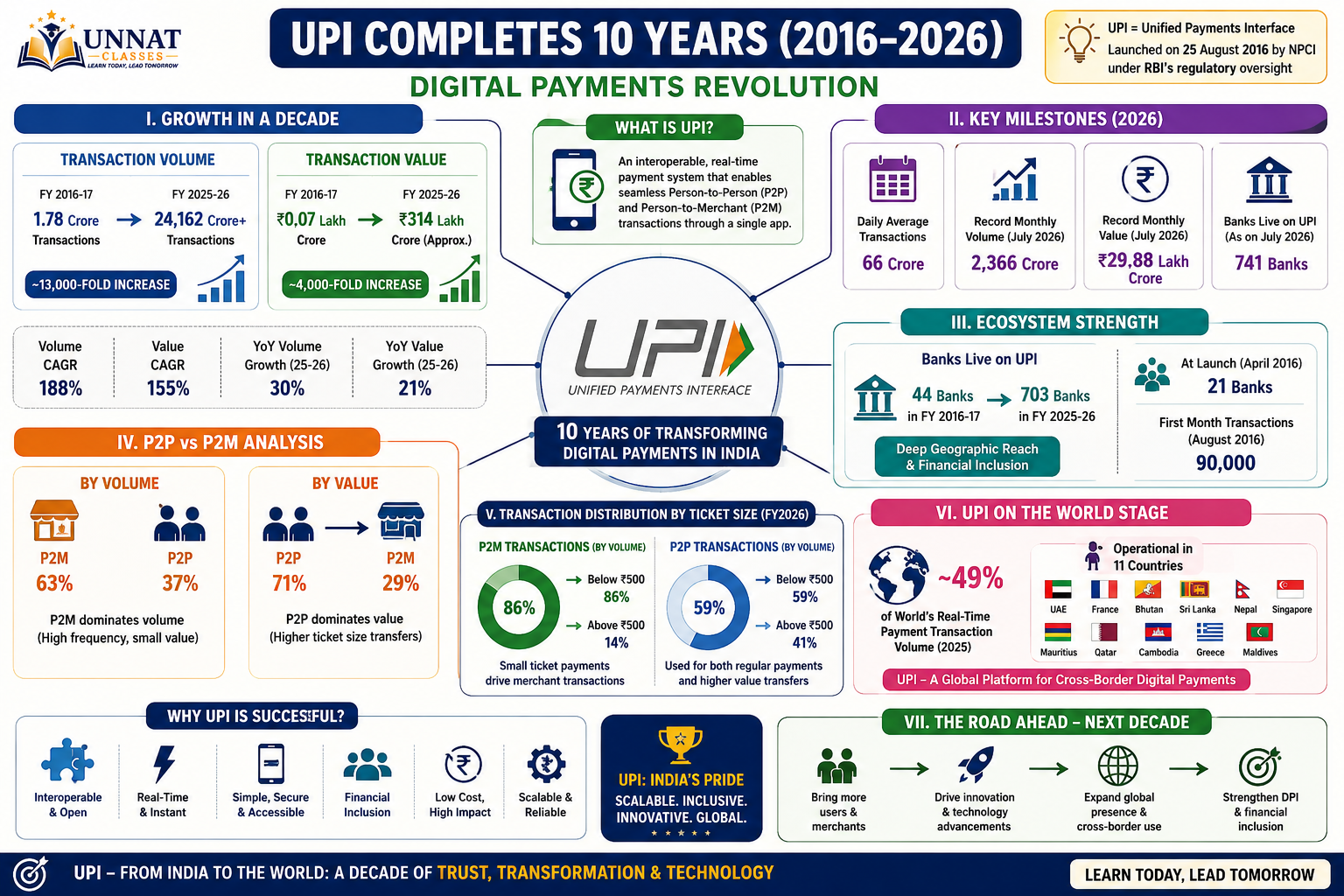
Volume CAGR: 188%
Value CAGR: 155%
YoY Volume Growth (2025–26): 30%
YoY Value Growth (2025–26): 21%
UPI's Role in Digital Public Infrastructure
UPI has emerged as one of the most successful components of India's Digital Public Infrastructure (DPI).
It provides an interoperable, real-time payments platform that enables seamless:
Person-to-Person (P2P) transactions
Person-to-Merchant (P2M) transactions
Digital payments
Instant fund transfers
Merchant payments
Why is UPI Important?
UPI has helped:
Expand digital payments
Improve financial inclusion
Reduce dependence on cash
Bring more merchants into the digital economy
Enable real-time transactions
Expand access to digital financial services
Increase participation in the formal economy
UPI has transformed digital payments from a technology-driven service into an everyday financial utility for millions of Indians.
UPI's Growth in 2026
The year 2026 marked another significant milestone in UPI's growth.
Monthly transaction volumes crossed 2,300 crore transactions for the first time in May 2026, reaching 2,320 crore transactions.
The growth continued in July 2026.
July 2026 Record
2,366 crore transactions
were processed in July 2026, making it the highest monthly transaction volume in UPI's decade-long journey.
The corresponding transaction value reached:
₹29.88 lakh crore
Banking Ecosystem and UPI
UPI has witnessed significant expansion in the number of participating banks.
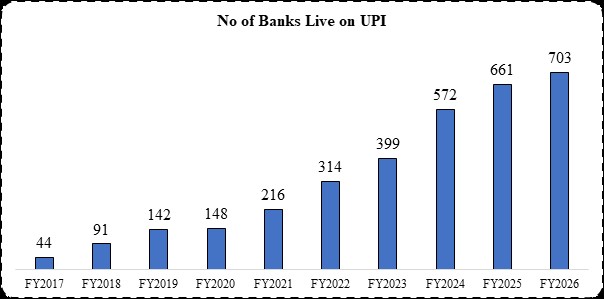
The number of banks live on UPI increased from:
44 banks in FY 2016–17
to
703 banks in FY 2025–26.
As of July 2026, the number of banks live on UPI stood at:
741 Banks
The participating institutions include:
Public sector banks
Private sector banks
Small finance banks
Payment banks
Cooperative banks
This broad participation has helped provide UPI with a deep geographic reach across India.
UPI at Launch
At the time of launch in April 2016, UPI had:
21 banks
participating in the ecosystem.
During its first month of operations in August 2016, UPI processed approximately:
90,000 transactions
The subsequent growth demonstrates the rapid adoption of India's interoperable digital payment infrastructure.
P2P vs P2M Transactions
UPI transactions can broadly be divided into:
P2P — Person to Person
These are transactions between individuals.
Examples include:
Sending money to family
Splitting bills
Transferring money to friends
P2M — Person to Merchant
These are payments made by individuals to merchants.
Examples include:
Retail purchases
Food payments
Online shopping
Utility payments
Small business transactions
Volume vs Value: An Important Distinction
An interesting feature of UPI is the difference between transaction volume and transaction value across P2P and P2M payments.
According to the PIB data:
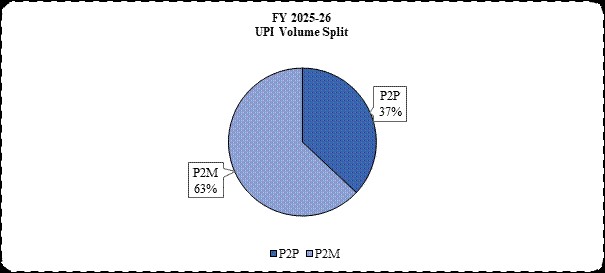
P2M transactions account for 63% of total transaction volume.
This reflects the widespread use of UPI for frequent, small-value retail payments.
In contrast:
P2P transactions account for 71% of transaction value.
This indicates their greater contribution to relatively higher-value transfers between individuals.
Exam Point
P2M dominates transaction volume, while P2P dominates transaction value.
This distinction is important for understanding the changing nature of India's digital payment ecosystem.
Micro-Payments Dominate UPI Usage
UPI has become deeply integrated into everyday retail transactions.
In FY2026:
86% of P2M transactions were below ₹500.
This demonstrates the importance of UPI for routine, low-value merchant payments.
For P2P transactions:
59% were below ₹500, while 41% were above ₹500.
This highlights UPI's versatility in handling both small everyday payments and larger fund transfers.
UPI on the Global Stage
UPI has evolved from a domestic payment innovation into a global benchmark for real-time digital payments.
As of 2025, UPI accounted for nearly:
49% of the World's Real-Time Payment Transaction Volume
The platform's global scale has received recognition from the International Monetary Fund (IMF).
UPI processes approximately:
66 crore transactions per day
This scale has strengthened India's position as a global leader in instant, secure and inclusive digital payments.
UPI in 11 Countries
UPI has expanded beyond India's borders and is currently operational in 11 countries.
These are:
United Arab Emirates
France
Bhutan
Sri Lanka
Nepal
Singapore
Mauritius
Qatar
Cambodia
Greece
Maldives
This international expansion demonstrates UPI's growing role as a platform for cross-border digital payments.
Why UPI is a Successful Digital Public Infrastructure
UPI's success is based on several important characteristics:
- Interoperability
Different banks and payment applications can operate on the same payment infrastructure.
- Real-Time Payments
Transactions are processed almost instantly.
- Accessibility
UPI enables digital payments across different segments of society.
- Scalability
The system can process extremely large transaction volumes.
- Financial Inclusion
UPI has expanded access to digital financial services.
- Merchant Integration
Small and large merchants can accept digital payments easily.
- Cross-Border Potential
UPI is increasingly being used for international digital payments.
UPI and Financial Inclusion
One of the major contributions of UPI has been its role in financial inclusion.
By enabling convenient digital transactions, UPI has helped connect individuals and businesses to the formal digital financial ecosystem.
It has particularly supported:
Small merchants
Micro-businesses
Rural users
Small-value transactions
Digital banking users
Digital payments can become an important instrument for broad-based economic participation when they are accessible, interoperable and affordable.
UPI and India's Digital Economy
UPI has become an important foundation of India's rapidly expanding digital economy.
Its growth demonstrates how digital infrastructure can:
Reduce transaction friction
Improve payment efficiency
Support entrepreneurship
Enable small businesses
Promote formalisation
Increase digital financial participation
The Road Ahead
The next decade of UPI is expected to focus on further expansion of India's digital payment ecosystem.
Key areas include:
Bringing more users into the UPI ecosystem
Bringing more merchants onto digital payments
Technological innovation
Greater financial inclusion
International expansion
Cross-border payments
Strengthening India's Digital Public Infrastructure
The Government of India remains committed to supporting the next phase of UPI-led innovation and digital financial inclusion.
UPI: The Decade in Numbers
Indicator Figure
Launch 25 August 2016
Transactions FY2016–17 1.78 crore
Transactions FY2025–26 24,162+ crore
Volume increase ~13,000-fold
Value FY2016–17 ₹0.07 lakh crore
Value FY2025–26 ~₹314 lakh crore
Value increase 4,000+ fold
Volume CAGR 188%
Value CAGR 155%
Daily average transactions in 2026 66 crore
July 2026 transactions 2,366 crore
July 2026 transaction value ₹29.88 lakh crore
Banks live on UPI, July 2026 741
Countries operational 11
Global real-time payment volume share ~49%
Significance for UPSC & UPPSC
This topic is highly relevant to:
Indian Economy
Digital Economy
Digital Public Infrastructure
Financial Inclusion
Banking & Payments
Science & Technology
FinTech
Internationalisation of Indian Digital Infrastructure
Inclusive Growth
Economic Formalisation
Governance & Public Infrastructure
Prelims Quick Facts
Q1. UPI was launched by which organisation?
Answer: National Payments Corporation of India (NPCI)
Q2. Under whose regulatory oversight does UPI operate?
Answer: Reserve Bank of India (RBI)
Q3. On which date was UPI launched?
Answer: 25 August 2016
Q4. What was the annual UPI transaction volume in FY2016–17?
Answer: 1.78 crore transactions
Q5. What was the annual UPI transaction volume in FY2025–26?
Answer: More than 24,162 crore transactions
Q6. How many countries currently have UPI operations according to the PIB release?
Answer: 11 countries
Q7. What share of global real-time payment transaction volume did UPI account for in 2025?
Answer: Nearly 49%
Q8. Which type of UPI transaction accounts for a larger share of transaction volume?
Answer: P2M — Person-to-Merchant
Q9. Which type accounts for a larger share of transaction value?
Answer: P2P — Person-to-Person
Q10. How many banks were live on UPI as of July 2026?
Answer: 741 banks
Important Numbers for Revision
10 years → UPI's journey completed in August 2026
1.78 crore → 24,162+ crore → Annual transaction volume
~13,000-fold → Increase in transaction volume
₹0.07 lakh crore → ₹314 lakh crore → Annual transaction value
4,000+ fold → Increase in transaction value
741 banks → Banks live on UPI as of July 2026
66 crore → Average daily transactions in 2026
2,366 crore → Record monthly transactions in July 2026
₹29.88 lakh crore → Record monthly transaction value in July 2026
11 countries → International operational presence
49% → Approximate share of global real-time payment volume in 2025
Possible UPSC / UPPSC Prelims Question
Consider the following statements regarding the Unified Payments Interface (UPI):
UPI was launched by NPCI under the regulatory oversight of RBI.
UPI enables both Person-to-Person and Person-to-Merchant transactions.
P2M transactions account for a larger share of transaction value than P2P transactions.
UPI is currently operational in 11 countries according to the PIB release.
Which of the statements given above are correct?
Answer: 1, 2 and 4 only
Possible Mains Question
“UPI has emerged as a successful example of India's Digital Public Infrastructure, combining scalability, interoperability and financial inclusion.” Discuss.
Mains Answer Framework
Introduction
The Unified Payments Interface (UPI) has transformed India's digital payments ecosystem by providing an interoperable, real-time payment infrastructure connecting banks, users and merchants.
Key Contributions
- Financial Inclusion
UPI has expanded access to convenient digital financial services.
- Digital Public Infrastructure
It demonstrates how interoperable public digital infrastructure can operate at massive scale.
- Merchant Digitisation
Small and large merchants can accept digital payments with ease.
- Low-Value Payments
The high share of small-ticket P2M transactions demonstrates its integration into everyday commerce.
- Global Leadership
UPI accounts for nearly 49% of global real-time payment transaction volume according to the PIB release.
- Internationalisation
Its presence in 11 countries demonstrates the growing global relevance of India's payment technology.
- Economic Formalisation
Digital transactions can support greater transparency and participation in the formal economy.
Challenges / Way Forward
India must continue focusing on:
Cybersecurity
Data protection
Fraud prevention
Digital literacy
System resilience
International interoperability
Financial inclusion of digitally underserved populations
Conclusion
UPI's decade-long journey demonstrates how technology, public infrastructure, regulatory support and private-sector innovation can combine to create a scalable digital ecosystem. Its continued expansion can strengthen India's position as a global leader in Digital Public Infrastructure and real-time payments.
One-Liner Revision
UPI → NPCI + RBI → 25 August 2016 → 10 Years → 24,162+ crore annual transactions → ₹314 lakh crore value → 741 banks → 11 countries → ~49% global real-time payment volume
Final Takeaway
UPI is not merely a payment system; it has become a major pillar of India's Digital Public Infrastructure.
Its decade-long growth from 1.78 crore transactions in FY2016–17 to more than 24,162 crore in FY2025–26 demonstrates the scale at which India's digital payment infrastructure has evolved.
For UPSC, UPPSC, State PCS and other competitive examinations, remember UPI through five keywords:
NPCI → RBI → Digital Public Infrastructure → Financial Inclusion → Global Digital Payments