Ken–Betwa Link Project: Complete Current Affairs for UPSC, UPPSC & State PCS
Ken–Betwa Link Project (KBLP)
The Ken–Betwa Link Project (KBLP) is one of India's most important river-linking and water-resource development projects. It aims to transfer water from the Ken River basin to the Betwa River basin, primarily to improve water availability in the drought-prone Bundelkhand region of Madhya Pradesh and Uttar Pradesh.
The project is particularly important from the perspective of Indian Geography, Environment & Ecology, Water Resources, Inter-State Issues, Agriculture, Sustainable Development and Government Schemes.
Why is Ken–Betwa Link Project in the News?
The Press Information Bureau (PIB) released a detailed backgrounder on the Ken–Betwa Link Project on 21 August 2026, covering its implementation status, benefits, rehabilitation and resettlement, environmental safeguards and impact on local communities.
Key Facts at a Glance
Project: Ken–Betwa Link Project (KBLP)
Purpose: Transfer water from the Ken basin to the Betwa basin
Region: Bundelkhand
States: Madhya Pradesh and Uttar Pradesh
Main structure: Daudhan Dam
Dam height: 96.7 metres
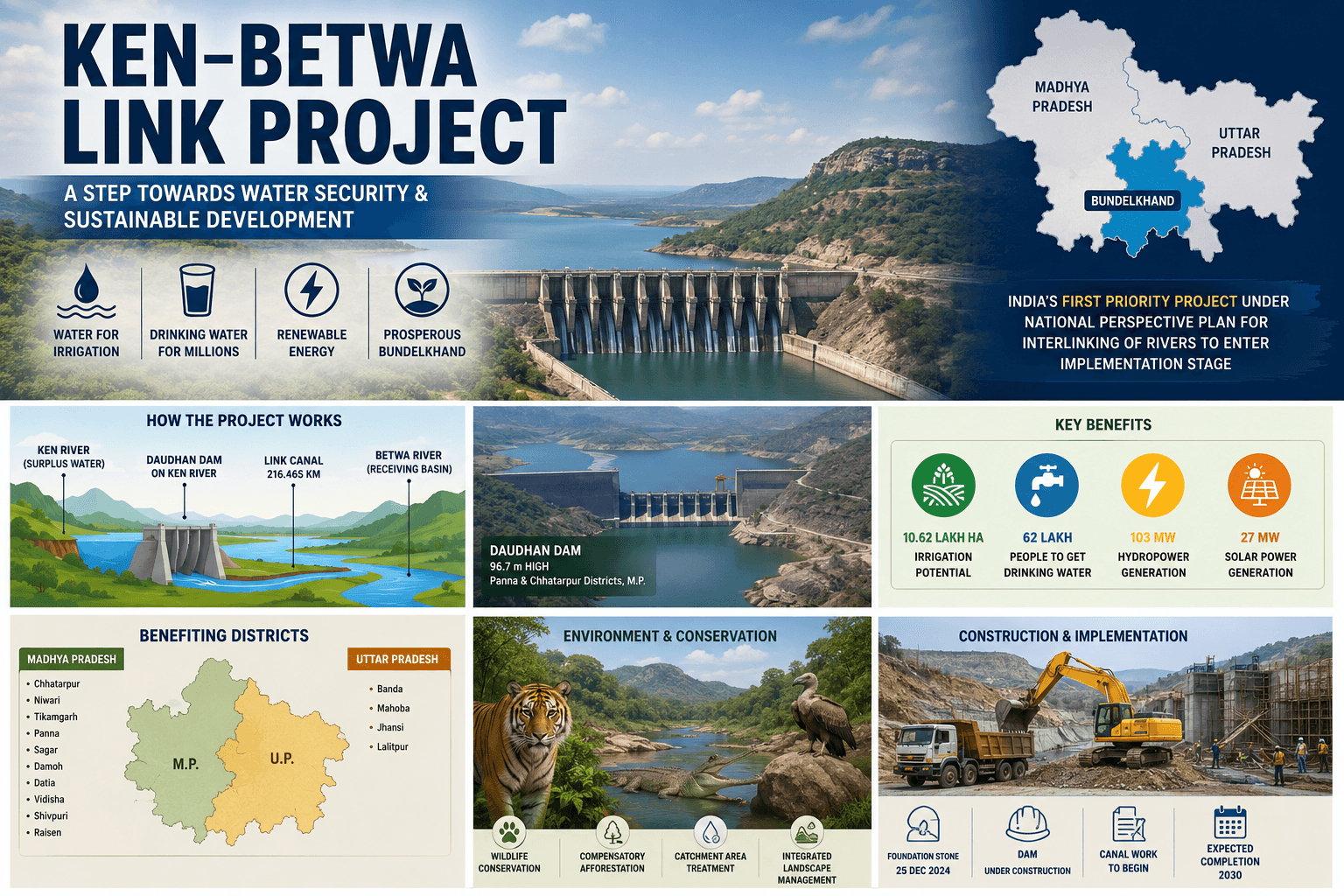
Link canal length: 216.465 km
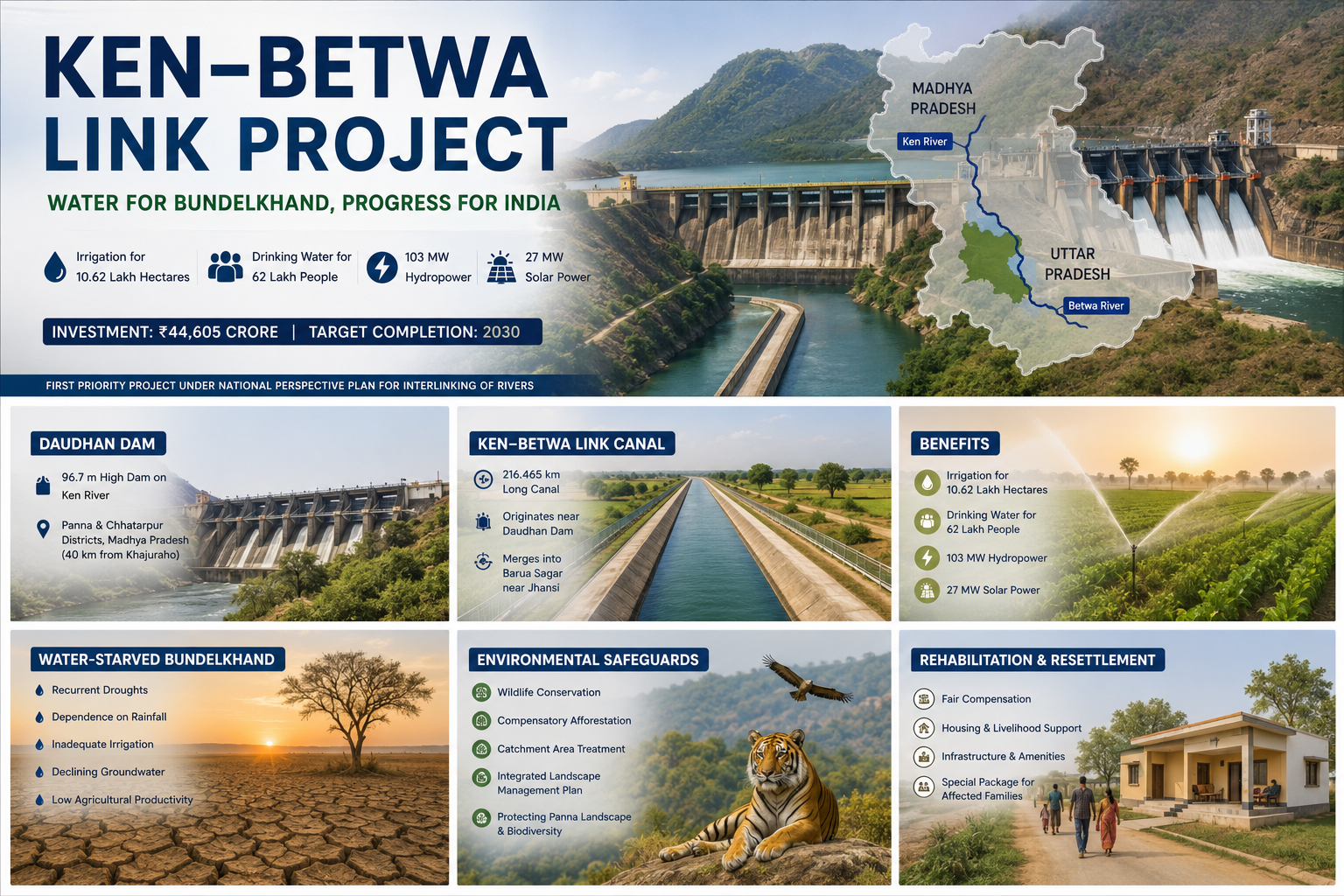
Total project cost: ₹44,605 crore
Foundation stone: 25 December 2024
Expected completion: 2030
Irrigation potential: 10.62 lakh hectares
Drinking water: About 62 lakh people
Hydropower: 103 MW
Solar power: 27 MW
What is the Ken–Betwa Link Project?
The project envisages transferring water from the Ken River to the Betwa River through a system consisting of the Daudhan Dam, link canal and associated infrastructure.
The Ken–Betwa Link Project is significant because it is the first priority project under the National Perspective Plan for Interlinking of Rivers to enter the implementation stage.
The 96.7-metre-high Daudhan Dam is being constructed on the Ken River in Panna and Chhatarpur districts of Madhya Pradesh, approximately 40 km from Khajuraho.
The 216.465-km-long Ken–Betwa Link Canal will originate near the Daudhan Dam and merge into Barua Sagar near Jhansi. Other components include the Lower Orr Project, Kotha Barrage and Bina Complex Multipurpose Project.
Why is the Project Important for Bundelkhand?
Bundelkhand has historically faced:
Recurrent water scarcity
Dependence on monsoon rainfall
Inadequate irrigation facilities
Declining groundwater availability
Drought vulnerability
The project is intended to improve water security, irrigation and drinking-water availability, while also supporting renewable energy and regional economic development.
Major Expected Benefits
The project is expected to:
- Improve irrigation
It will provide irrigation to approximately 10.62 lakh hectares of agricultural land.
- Provide drinking water
Around 62 lakh people are expected to benefit from drinking-water provisions.
- Generate renewable energy
The project includes:
103 MW hydropower generation
27 MW solar power generation
- Strengthen agriculture
More reliable irrigation can reduce dependence on uncertain rainfall and support:
Higher cropping intensity
Greater crop productivity
Crop diversification
High-value crops
Better farm incomes
Greater drought resilience
Which Areas Will Benefit?
The project covers drought-prone areas of Madhya Pradesh and Uttar Pradesh.
Important districts mentioned in the PIB backgrounder include:
Madhya Pradesh:
Chhatarpur, Niwari, Tikamgarh, Panna, Sagar, Damoh, Datia, Vidisha, Shivpuri and Raisen.
Uttar Pradesh:
Banda, Mahoba, Jhansi and Lalitpur.
For UPPSC and UP State PCS, the connection with Bundelkhand, Jhansi, Lalitpur, Banda and Mahoba makes this particularly important.
Environmental Concerns
The project has significant environmental considerations because of its relationship with the Panna landscape and Panna Tiger Reserve.
Environmental safeguards include:
Environmental Management Plan
Compensatory afforestation
Wildlife conservation
Biodiversity protection
Catchment-area treatment
Integrated Landscape Management Plan (ILMP)
The Greater Panna Landscape is being addressed through landscape-level conservation planning.
The project also involves conservation measures for species such as the Tiger, Vulture and Gharial.
Land Acquisition, Rehabilitation & Resettlement
The project has also raised important issues concerning Project Affected Families (PAFs).
In Madhya Pradesh, 22 villages are affected:
8 villages in Panna
14 villages in Chhatarpur
The project provides for compensation and Rehabilitation & Resettlement (R&R) under applicable laws.
The Special Package announced by the Government of Madhya Pradesh includes compensation for acquired land, houses, trees, wells and other assets, along with assistance for eligible affected families.
Important Environmental & Legal Clearances
The project has received various statutory clearances, including:
Environmental Clearance
Wildlife Clearance
Clearance from the Ministry of Tribal Affairs
Forest Clearance
The environmental impacts were assessed as part of the statutory clearance process, followed by prescribed mitigation and conservation measures.
UPSC / UPPSC Exam Perspective
Important Concepts to Revise
Ken River
River involved in the interlinking project
Associated with the Bundelkhand region
Betwa River
Receives water through the Ken–Betwa Link
Bundelkhand
Region spread across Uttar Pradesh and Madhya Pradesh
Characterised by recurring drought and water scarcity
Daudhan Dam
Key infrastructure of the project
Located in Madhya Pradesh
Panna Tiger Reserve
Important environmental dimension of the project
River Interlinking
A major component of India's water-resource planning
Raises questions related to water security, ecology, displacement, federalism and sustainable development
Possible Prelims Questions
Q1. The Ken–Betwa Link Project is associated with which region?
A. Malwa
B. Bundelkhand
C. Marathwada
D. Vidarbha
Answer: B. Bundelkhand
Q2. Consider the following statements about the Ken–Betwa Link Project:
It involves transfer of water from the Ken basin to the Betwa basin.
Daudhan Dam is an important component of the project.
The project is located entirely within Uttar Pradesh.
Which of the statements given above is/are correct?
Answer: 1 and 2 only
Q3. Which of the following states are associated with the Ken–Betwa Link Project?
Uttar Pradesh
Madhya Pradesh
Rajasthan
Bihar
Select the correct answer:
Answer: 1 and 2 only
Mains Perspective
The Ken–Betwa Link Project can be used in answers related to:
Interlinking of Rivers in India
Water Security
Drought Management
Bundelkhand Development
Irrigation and Agriculture
Environmental Impact Assessment
Human-Wildlife Conservation
Rehabilitation and Resettlement
Sustainable Development
Centre-State and Inter-State Water Issues
Mains Question
“River interlinking can enhance water security but may also create ecological and social challenges.” Discuss with reference to the Ken–Betwa Link Project.
Conclusion
The Ken–Betwa Link Project represents an attempt to address the interconnected challenges of water scarcity, irrigation, drinking water, energy and regional development in Bundelkhand. At the same time, its long-term success will depend on balancing development objectives with environmental conservation, rehabilitation of affected communities and sustainable water management.