India Restored 21.76 Million Hectares of Land During 2011–2020: Land Restoration, Employment & Sustainable Development
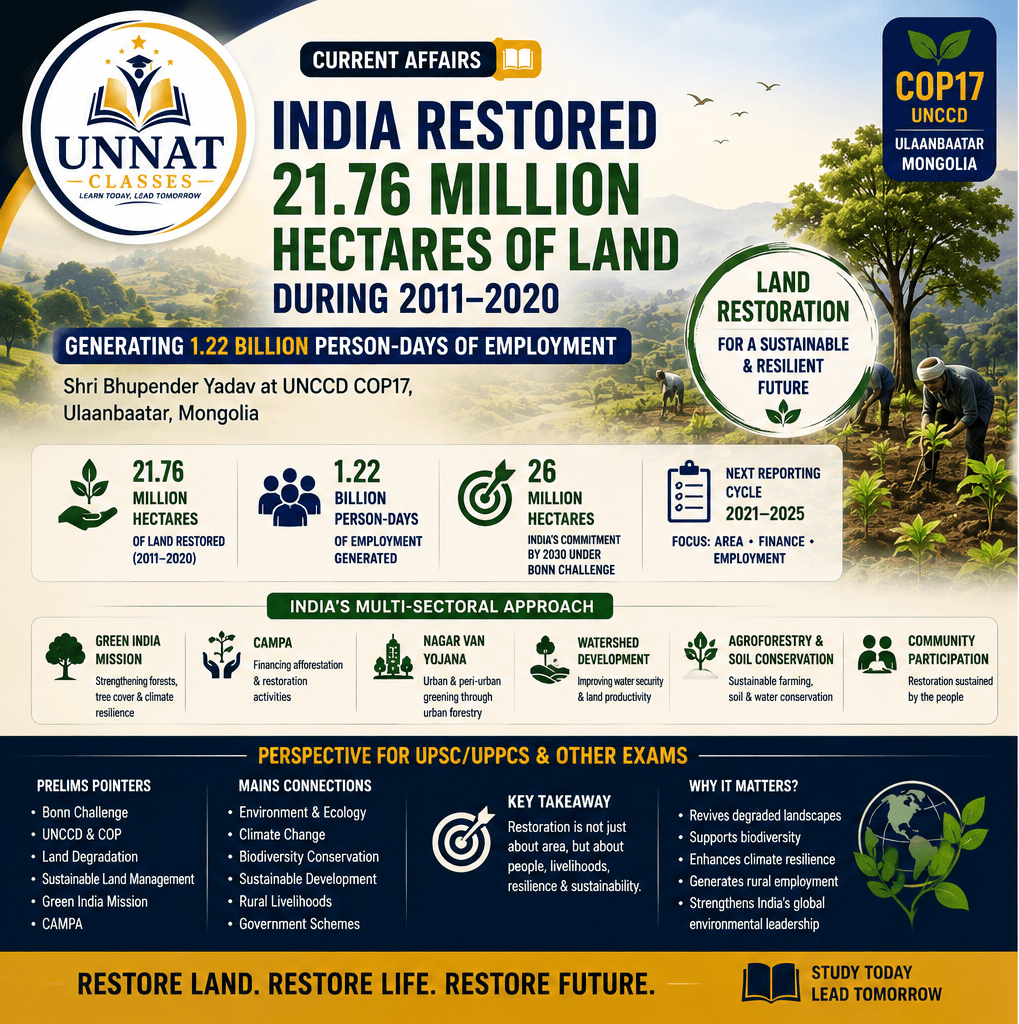
India and Land Restoration
Union Minister for Environment, Forest and Climate Change Shri Bhupender Yadav stated that land restoration is an established national priority for India.
Speaking at a side event organised by the International Union for Conservation of Nature (IUCN) during the 17th Conference of the Parties (COP17) to the United Nations Convention to Combat Desertification (UNCCD) in Ulaanbaatar, Mongolia, the Minister highlighted India's approach towards restoring degraded land.
India views land restoration not as a standalone environmental intervention but as an essential component of:
Sustainable Land Management
Biodiversity Conservation
Climate Action
Rural Development
Sustainable and Resilient Development
Key Facts at a Glance
Event: UNCCD COP17
Venue: Ulaanbaatar, Mongolia
Indian Minister: Shri Bhupender Yadav
Initial Bonn Challenge commitment: 2015
Enhanced restoration commitment: 26 million hectares by 2030
Land restored during 2011–2020: 21.76 million hectares
Employment generated: Approximately 1.22 billion person-days
Next reporting cycle: 2021–2025
Key dimensions: Area restored + Financial flows + Employment generated
What is the Bonn Challenge?
The Bonn Challenge is a global effort aimed at bringing degraded and deforested landscapes under restoration.
India made its initial commitment to restore degraded and deforested land under the Bonn Challenge in 2015.
India subsequently enhanced its commitment to restore 26 million hectares by 2030.
Why is India's Bonn Challenge Commitment Important?
Land degradation can negatively affect:
Agricultural productivity
Soil health
Water availability
Biodiversity
Ecosystem services
Rural livelihoods
Climate resilience
Land restoration can therefore contribute simultaneously to environmental protection and socio-economic development.
India's Progress: 2011–2020
India's Second Progress Report on the Bonn Challenge covers the period 2011–2020.
During this period:
21.76 Million Hectares
of land were brought under restoration.
At the same time, restoration activities generated approximately:
1.22 Billion Person-Days
of employment.
This demonstrates that land restoration can produce both:
Environmental Outcomes + Socio-Economic Outcomes
Restoration can revive degraded landscapes while also creating employment and supporting rural livelihoods.
Restoration is More Than Just Hectares
An important aspect of India's assessment is that restoration is not measured only by the number of hectares restored.
The assessment considers restoration across different land-use systems, including:
Forests
Agriculture
Soil conservation
Water conservation
Other land-use systems
This reflects the principle that restoration strategies should be adapted to the ecological and socio-economic characteristics of individual landscapes.
Important Concept
Successful land restoration is not simply about increasing the area restored; it is about achieving measurable and lasting ecological and socio-economic outcomes.
Next Reporting Cycle: 2021–2025
India is undertaking its next reporting cycle covering 2021–2025.
The process is being undertaken in collaboration with:
ICFRE Centre of Excellence on Sustainable Land Management
IUCN
The next reporting cycle will focus on three major dimensions:
- Area Restored
Measuring the extent of land brought under restoration.
- Financial Flows
Tracking financial resources supporting restoration activities.
- Employment Generated
Assessing employment and livelihood impacts associated with restoration.
This approach aims to strengthen India's national evidence base for land restoration.
India's Multi-Sectoral Approach
India's approach recognises that land restoration cannot be achieved through a single programme or sector.
It requires convergence across:
Landscapes + Sectors + Levels of Governance
This includes cooperation among:
Local communities
State Governments
Union Government
Scientific institutions
Civil society
International organisations
Private sector and financial institutions
Major Indian Initiatives Supporting Restoration
- Green India Mission
The Green India Mission focuses on strengthening:
Forest and tree cover
Ecosystem services
Climate resilience
It is an important component of India's broader environmental and climate strategy.
- CAMPA
The Compensatory Afforestation Fund Management and Planning Authority (CAMPA) directs substantial resources towards:
Compensatory afforestation
Restoration activities
Forest-related interventions
3. Nagar Van Yojana
The Nagar Van Yojana extends the restoration and greening agenda to urban and peri-urban areas.
It promotes:
Urban forestry
Green spaces
Improved urban ecological conditions
4. Watershed Development
Watershed development contributes to:
Water conservation
Soil conservation
Sustainable land management
Agricultural resilience
5. Agroforestry
Agroforestry integrates trees with agricultural systems and can contribute to:
Soil health
Biodiversity
Climate resilience
Livelihood diversification
6. Soil and Water Conservation
Soil and water conservation measures help improve the long-term productivity and ecological health of landscapes.
- Community-Based Restoration
Local communities play an important role in restoring and managing landscapes because they are directly dependent upon natural resources.
Why is Land Restoration Important?
Land degradation can create interconnected environmental and socio-economic problems.
Restoration can help:
Improve soil health
Protect biodiversity
Strengthen ecosystem services
Improve water security
Increase climate resilience
Support agriculture
Create employment
Strengthen rural livelihoods
Therefore, land restoration can serve as a bridge between environmental conservation and sustainable development.
Land Restoration and Climate Action
Land and ecosystems play an important role in addressing climate change.
Restoration of forests, agricultural landscapes and other ecosystems can contribute to:
Carbon sequestration
Improved ecosystem resilience
Protection of natural resources
Climate adaptation
Sustainable land management
Thus, land restoration is closely connected with India's broader climate action objectives.
Land Restoration and Biodiversity Conservation
Healthy landscapes provide habitats for numerous species.
Restoration can help improve:
Habitat quality
Ecological connectivity
Biodiversity
Ecosystem functioning
Ecosystem services
Therefore, land restoration and biodiversity conservation are closely interconnected.
Land Restoration and Rural Employment
The figure of 1.22 billion person-days of employment highlights an important socio-economic dimension of restoration.
Restoration activities can generate employment through:
Afforestation
Soil conservation
Watershed development
Land management
Ecosystem restoration
Community-based conservation
This makes restoration particularly relevant for rural development and livelihood generation.
Looking Beyond 2030
India's objective is not simply to restore a larger area of land.
The emphasis is increasingly on:
Restore More + Restore Better + Finance Better + Measure Better
Future restoration efforts will require:
Innovative financing mechanisms
Greater public investment
Increased private investment
Stronger monitoring systems
Better scientific evidence
Regional partnerships
International cooperation
Greater community participation
Role of Local Communities
The Minister emphasised that restoration is ultimately sustained by the people who depend upon and manage these landscapes.
Therefore, successful restoration requires meaningful participation of local communities.
Key Idea
Restoration cannot be sustainable without the participation of the communities that live in and depend upon restored landscapes.
Significance for UPSC & UPPSC
This topic is highly relevant to:
Environment & Ecology
Land Degradation
Land Restoration
Desertification
Biodiversity Conservation
Climate Change
Sustainable Development
Forest Conservation
Watershed Management
Agroforestry
Rural Development
Ecosystem Services
International Environmental Conventions
Bonn Challenge
UNCCD
Community-Based Conservation
Prelims Quick Facts
Q1. India enhanced its Bonn Challenge commitment to restore how much land by 2030?
Answer: 26 million hectares
Q2. How much land did India bring under restoration during 2011–2020?
Answer: 21.76 million hectares
Q3. Approximately how many person-days of employment were generated during this period?
Answer: 1.22 billion person-days
Q4. India made its initial Bonn Challenge commitment in which year?
Answer: 2015
Q5. The recent discussion on India's land restoration efforts took place during which international conference?
Answer: 17th Conference of the Parties (COP17) to UNCCD
Q6. Where was UNCCD COP17 being held?
Answer: Ulaanbaatar, Mongolia
Q7. Which organisation was associated with the side event where the Indian Environment Minister spoke?
Answer: IUCN
Q8. India's next reporting cycle for restoration covers which period?
Answer: 2021–2025
Important Numbers for Revision
2015 → India's initial Bonn Challenge commitment
26 million hectares → India's enhanced restoration commitment by 2030
21.76 million hectares → Land restored during 2011–2020
1.22 billion person-days → Employment generated
2021–2025 → Next reporting cycle
3 dimensions → Area restored + Financial flows + Employment generated
Possible UPSC / UPPSC Prelims Question
Consider the following statements regarding India's land restoration efforts:
India made its initial commitment under the Bonn Challenge in 2015.
India has enhanced its commitment to restore 26 million hectares by 2030.
India restored 21.76 million hectares during 2011–2020.
The assessment of restoration considers only forest areas.
Which of the statements given above are correct?
Answer: 1, 2 and 3 only
Possible Mains Question
“Land restoration is not merely an environmental intervention but an important instrument of climate action, biodiversity conservation and rural development.” Discuss in the context of India's land restoration efforts.
Mains Answer Framework
Introduction
Land degradation affects ecosystems, agricultural productivity, water resources, biodiversity and rural livelihoods. Therefore, land restoration has emerged as an important component of sustainable development.
India's Progress
India made its initial Bonn Challenge commitment in 2015.
The commitment was enhanced to 26 million hectares by 2030.
21.76 million hectares were brought under restoration during 2011–2020.
These efforts generated approximately 1.22 billion person-days of employment.
Environmental Benefits
Biodiversity conservation
Ecosystem restoration
Improved soil health
Water conservation
Carbon sequestration
Climate resilience
Socio-Economic Benefits
Rural employment
Improved livelihoods
Agricultural resilience
Community participation
Sustainable rural development
Challenges
Monitoring restoration outcomes
Tracking financial flows
Measuring livelihood impacts
Mobilising adequate financing
Ensuring long-term sustainability
Strengthening community participation
Way Forward
India needs:
Innovative financing
Stronger monitoring
Scientific assessment
Public-private partnerships
International cooperation
Community participation
Landscape-based planning
Conclusion
India's experience demonstrates that land restoration can simultaneously address environmental degradation, climate change, biodiversity loss and rural livelihood challenges. The next phase should focus not only on restoring more land but on restoring better and delivering measurable, durable outcomes.
One-Liner Revision
Bonn Challenge → 26 million ha by 2030 → 21.76 million ha restored during 2011–2020 → 1.22 billion person-days employment → Restoration + Biodiversity + Climate Action + Rural Development
Final Takeaway
India's land restoration strategy demonstrates a shift from treating restoration as an isolated environmental activity towards a multi-sectoral, landscape-based and community-oriented approach.
The key message for competitive examinations is:
Land restoration = Environmental Conservation + Climate Action + Biodiversity + Rural Employment + Sustainable Development
India's future restoration efforts will increasingly depend on strong institutions, sustained financing, scientific monitoring, innovative financial mechanisms and active participation of local communities.